
Police chief resigns
By:
Jill Meier, Journal editor
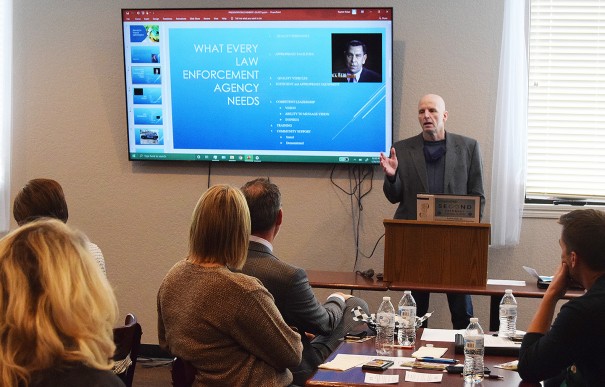
Jill Meier/BV Journal
Three days after Brandon Police Chief Joe Weir was the guest speaker for the Brandon Valley Area Chamber of Commerce’s “On The Menu” luncheon, he tendered his resignation. Since he stepped into his role in April 2019, Weir has advocated for better police facilities and higher wages for his officers, leaving his position out of the wage increase equation. The council accepted his resignation on a 4-2 vote, specifying the resignation take immediate effect.
Brandon chief of police Joe Weir tendered his resignation on Friday, Jan. 29 after frustrations continued to mount in his efforts to secure better pay for his officers and adequate police facilities.
Weir did not include his position in the wage increase request.
At Monday night’s meeting, on a 4-2 vote, the Brandon City Council accepted Weir’s resignation, specifying it to be effective immediately. Alderwomen Vickie David and Dana Clark cast the dissenting votes.
Clark questioned why the motion to accept Weir’s resignation specified it to be “immediately.” She noted communication she had seen earlier in the day that said he would remain on staff “for a couple of weeks.”
Alderman Dave Kull, who made the motion to include “immediately,” said he did so because of “the tone and the tenor of the resignation letter.”
“Obviously, we have a person that is very unsatisfied with being here and I just feel that it’s best for the department to be able to move on,” Kull said.
Alderman Jack Parliament concurred.
“He’s not happy right now, and I think it’s time for us to move on and support the guys that are sitting in the back of the room right now” Parliament said, gesturing to the officers in attendance. “They’re all curious what’s going to happen I’m sure, and this is a way to take one step forward right away.”
David said she can “respect the Chief’s wishes” but said she “is sad that it had to come to this.”
“I felt he did the best he could for the officers … He never once asked anything for himself; he wanted to make this a better community for us, and I think he has,” David said.
She added, “With a little more compromise and communication, I feel like this didn’t have to end this way.”
Clark agreed.
“I think it could have been prevented and I think he has some valid points in his resignation letter, particularly with pay. That’s something I’ve advocated for for a year, so I’ll save my comments on pay until we get to that agenda item. I do think he was a huge asset to our community and as I understand it, he was very liked and respected by the officers underneath him.”
Per policy, Mayor Paul Lundberg said personnel issues are not publicy discussed, therefore, declined to comment on Weir’s resignation letter.
“I am confident the city council will be discussing this matter in the coming weeks and public information will come available as to the direction they want to take in finding a replacement for the police chief position,” Lundberg said. “I do want to thank Chief Weir for his service to the City of Brandon, as his strong past experience has brought many positive benefits to this community.”
With Weir’s immediate departure, the council named Lieutenant Jamie Steffel as its interim chief. His pay will reflect his new role as interim chief. The council is expected to approve the wage increase at their Feb. 16 meeting and noted it would be retroactive to Feb. 2.
In his resignation letter, Weir wrote that since he began in his role as Brandon’s chief of police on April 1, 2019, he has “endeavored to secure significant pay raises and new facilities for BPD personnel. Unfortunately, I have been unable to garner appropriate support for either of the quests. Without a resolution in sight, I see no reason for me to remain in a situation without a resolution or enhancement for such in the foreseeable future.”
Weir went on to say that “the deficient pay for BPD personnel and the sub-par facilities are readily apparent and obvious.”
“I feel I have done all I can do to unveil these deficiencies, articulate the need, and provide potential options to remedy the shortcomings. Yet, without more significant support, the improvements have not and will not happen. As I have accumulated more time on the BPD, I have gotten more frustrated by the lack of movement on these issues. The existing facilities and deficient pay are embarrassing as a professional, well below industry standards, and inequitable. I simply do not desire to be associated with such shortcomings,” he said.
Results of an August 2020 study—prepared by Weir—revealed that Brandon police officers are the lowest paid when compared with 10 South Dakota communities of similar size to Brandon. A starting officer in Brandon makes approximately $12,500 less per year than their peers in Sioux Falls, which Weir said, “is a large percentage shortfall when you are only making $42,889 a year.”
“The insufficient pay of Brandon Police officers reflects on me as a leader,” Weir said. “Leaders can have a great vison, but they are only effective leaders if they can get others to support it, so said vision can be implemented. After approximately seven months of discussion and no progress, I succumb.”
Weir went on to cite the wage discrepancy as “embarrassing.”
“Brandon Police Officers are dedicated professionals who deserve equitable pay in alignment with peer agencies and/or geographically adjacent agencies. Brandon officers will continue to carry out their duties and responsibilities regardless of pay, but civic leaders need to be just, fair, and equitable,” Weir wrote.
The city council addressed salary increases for all employees in late December, largely focusing on wage increases for police officers. During the Dec. 21 discussion, Kull noted the grade maximum for police officers in the proposed option 2 is $31.97, while the current top of the scale in Brandon is $28.88. The proposed increase equates to about a $2,800 annual wage increase per officer.
At the December meeting, Weir told the council that the Yankton Police Department would be raising its beginning salary to $23.25 per hour and the Sioux Falls Police Department was jumping up to $26.12. The starting wage in Sioux Falls equates to a $12,758 difference from Brandon’s wages. Option 2, as presented, would reduce the gap to $7,870, Weir said.
“When we talked in August, we talked about meeting halfway,” Weir said in December. “This is less than that, but to me, it’s a good start, and it’ll make our police wages more competitive.”
Kull, who served as Brandon’s chief of police for 10 years prior to Weir, supported the proposed increase (for all city staff) that resulted in a 3-3 tie, for which Mayor Paul Lundberg cast the dissenting vote. The proposed increase totaled about $90,000.
During the December discussion, Clark shared her concerns for the one-size-fits-all approach to the pay plan.
“I’m super in favor with the police side of this, but I really struggle with saying every employee has to get $3,000 [more] for the police to be paid appropriately,” she said.
The employee wage/pay scale was back on Monday’s agenda for council discussion.
Clark described the wage increase information the council was presented in December as “very vague information.”
“I wholeheartedly believe that you just made this topic so complex that we ended up doing nothing. When we tried to look at it as a whole and move it as one unit, it doesn’t work and it hasn’t worked,” she said.
Clark noted a resume of pay studies––the first, an internal pay study in 2017. The city’s HR director Julie Nelson also conducted a study in 2018, which included a set of parameters with a heavy emphasis on minimums. Most recently, a 2020 study featured an emphasis on comparing maximums and comparing to Sioux Falls.
“There’s not a one-size-fits-all answer to our departments. In some cases, geography matters. In some cases, it doesn’t, but what pains me is in all of the studies is police, for example, we’ve seen that we have an issue, we have a deficit. Because we continue to make it so complex, we continue to kick the can down the road, and that’s not right by our police force. … We’ve seen the studies. There’s a deficiency, and if anybody is curious how we compare to other cities, per capita, we are so grotesquely underspending of what other cities of similar size are spending.”
Clark said she reviewed a 2020 state police study, comparing Brandon to seven other South Dakota communities: Huron, Madison, Mitchell, Pierre, Spearfish, Vermillion and Yankton.
“They’re all way over us. In fact, the average of those seven per capita is 215, and Brandon is at 144. We’re under the average of those seven by 71 per capita. If you take our per capita number, that equates to over 700,000 that we are under if we were just to meet the average target, and all we need is 10 percent of that to make right by these officers,” Clark said. “I’m steering off here, because we don’t want to make this just about the officers, but we have something that’s come before us repeatedly and we’ve done nothing. What I am proposing is that we stop looking at this as a whole, and we look at these departments, we involve the department heads, we figure out parameters that are and are not important to get this situation and this topic dealt with once and for all.”
David said she can’t support the “one-size-fits-all” wage/pay scale theory.
“For taxpayer dollars, I don’t think of it as a ‘one-size-fits-all.’ If somebody gets a raise, everybody gets a raise. I don’t think that’s how businesses are run,” she said. “My fear with this whole thing was that you would have some getting a significant raise and others not getting piddly, and I don’t think that’s fair either. … That was why I didn’t vote for this the first time.”
Kull encouraged the council to reconsider option 2, which would increase a starting officer’s current wage from $21.34 per hour to $22.84.
“If we went with something like that, it buys us a year to fall forward. Wages are not something that you deal with one time and we’re done for all time. It’s a constant thing that has to be addressed,” Kull said. “It moves the ball down the court. It doesn’t solve it forever. It will be something that will be addressed time and time again, because that’s just the way wages are.”
Alderwoman Barb Fish reminded the council of the $90,000 wage increase that came with option 2.
“A $90,000 ticket?” Kull posed. “We just spent $375,000 additionally last year for the golf course and we didn’t hardly blink an eye. We talk about trucks, we talk about plows, cars and everything, but the most important commodity that we have, the most important people that we have are the ones that drive the squad cars, drive the snow plows and take care of the water and make sure our sewer works, and everybody had a hang up about $90,000, yet we supplement golf for people every year. All $90,000 didn’t just go to the police department. It also went to other staff and for some reason, the two people (referring to David and Clark) really supporting the police wages going up and the police department did see the bump in that, and it got voted down and here we sit again. We’re talking about complicating something more than it really needs to be.”
Lundberg said the council continues to work through pay scales, not only for police officers but for all the categories of staff within the city.
“Financial decisions are complex in nature but are not taken lightly,” he said. “As a council, we are challenged with requests that far exceed our resources, so it becomes a balancing act trying to decide where our limited resources/funding should be placed.”
For example, Lundberg said during the 2021 budget process, the council approved a new detective position, which comes at a significant cost.
‘We are continuously balancing all facets of city government while still maintaining fiscal responsibility,” he said, adding that it is important to factor in the comprehensive benefits package (i.e., health insurance) that the city provides employees when determining comparability of compensation packages.
In the end, Lundberg––behind full council support––directed staff to provide the council with a calculated before/after wage/pay scale increase report, using option 2 as presented in December. Council will review the report at their Tuesday, Feb. 16 meeting.
Better facilities
The need for better police facilities was explained in an Aug. 12, 2020 BV Journal report, in which the results of an ISG-leg space study backed up the need for not only a new police station, but also a new City Hall. The report states that Brandon’s police facilities are significantly deficient, lacking a lobby, subject and victim interview rooms, temporary holding facility, evidence processing and storage rooms, a locker room and break/lunch room.
“I view Brandon as an up and coming city. We’re a growing city and we need to act like it and present like it. Image is important,” Weir said in the Journal report. “I’ve been in law enforcement for 37 years and there are very few buildings I have been in that are as deficient as Brandon’s, let alone communities much smaller than Brandon have much better facilities than Brandon has.”
Lundberg reminded that the council has spent the last several months reviewing an extensive list of projects that need to be done.
“Once again, the list of projects outweighs our limited sources of revenue. We have been actively looking at the future of Brandon facilities, and we will be continuing to review and prioritize its Capital Improvement Plan (CIP) throughout the coming weeks and months,” he said. “The CIP process has been a goal of mine as mayor and I believe has been very educational and informative to the council. Just a few weeks ago, we toured facilities to look towards the future and we have been in the process of planning, as mentioned with the CIP and can be seen in previous city council meetings. Major projects cannot happen overnight, but we are and have been working on plans for when the resources become abundantly available.”
City administration and the council look at all aspects of our resources and develop strategies to ensure Brandon thrives, he said, noting the facilities in discussion have been actively discussed and are part of the CIP.
Last month, the Journal reported on building renovations that were taken on by police department staff that included new paint, flooring, desks and space dedicated for dinner breaks. The effort was led by Lt. Steffel who first painted his office with help from his daughter, which inspired others to follow suit.
Prior to the renovations, officers dined at their desks, which Weir said was not ideal.
“We identified a problem where they were processing drug evidence and other stuff and an hour later, eating at the same desk,” Weir said in the Journal’s report. “That’s not healthy.”
Despite the functional upgrades, Weir and Steffel said that most of the changes have been aesthetic and both say that perception is a vitally important part of how the agency functions.
“I think, to a certain extent, the way people perceive you is so very important,” Weir said. “That’s one thing—having worked for the FBI and the Iowa State Patrol—we want to project a positive image of who we are as an agency and who we are as individuals.”
On Monday, the council turned down a $30,000 proposal from ISG to conduct a structural analysis and 3D scan, develop two to three concept floor plans and oversee the design through construction of a remodeled City Hall and possible addition on the building’s northside.
City administrator Bryan Read said it became evident through the CIP process that “a new City Hall is probably not in the cards for the short-term” and said ISG would come in and take a look at the existing facilities.
Fish suggested that the ISG proposal be put on pause, although Read said $80,000 to $85,000 is budgeted annually for government facilities/repairs. Read also suggested the project could forgo ISG’s proposal and the $30,000 could go to architectural fees.
“I just know we’re running out of room,” he said.
Read said offices and/or cubicles for staff may need to be expanded into the council chambers building located next to City Hall, which David voiced her support for.
Kull asked administration to put together some numbers to lease a building before any decisions are made on “patching” the combined City Hall/police station.
“Sometimes I think we’re throwing good money after bad,” he said.
Read estimated the city would pay between $400,000 and $450,000 for an annual lease payment.
The council meets next in regular session at 6 p.m. Tuesday, Feb. 16. The change of date is in respect to President’s Day.

