
Ellis & Eastern to rebuild, expand through Brandon
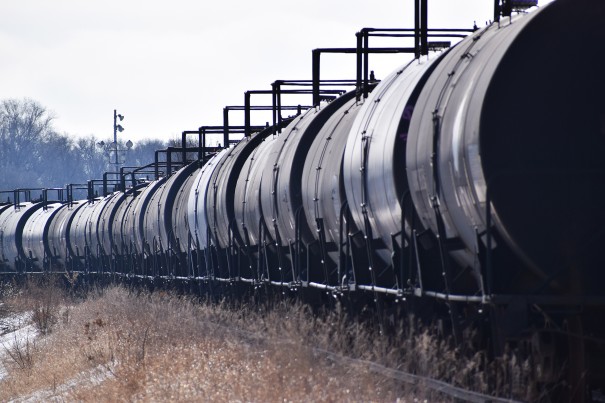
Ellis & Eastern Co. is a shortline railroad which operates during “normal” business hours of service. E&E does not have multiple shifts of crews to operate 24 hours a day. They estimate when a train passes through town at 10-15 mph, the estimated time to pass through a crossig would be a few minutes, about the same time as a traffic light wait. Jill Meier/BV Journal
Editor’s note: The BV Journal presented the following questions to Ellis & Eastern Company officials. Printed below are the company’s responses. The intent of this Q&A is to provide our readers with a better understanding of the railroad company’s plans to bring the 65.5 miles of tracks up to today’s safety standards.
What is the documented history of Ellis & Eastern Company?
The Ellis & Eastern Company is a railroad owned and operated by Sweetman Construction Company operating on former Chicago and Northwestern (CNW) trackage. It was formed in 1989 to ship Sioux quartzite and other materials such as sand and gravel from a large quarry in Sioux Falls for Sweetman Construction Co., which uses the railroad primarily to ship materials from the quarry it operates to a concrete plant nearby. Over time, the Ellis & Eastern has shipped more diverse products such as lumber, chemicals, machinery, scrap metals, and grain to other customers.
The dominant railroad in southern Minnesota was the Chicago and Northwestern, and by 1875 had all of its mainline complete in Minnesota. For the next 35 years, it would develop its branch lines, especially in Southwestern Minnesota. The line through Brandon was completed in approximately 1878 and the line was through Sioux Falls the same year. A post office was established at the Brandon location in 1878, yet Brandon was not incorporated until 1974.
About the same time Sweetman Construction Co. purchased the South Dakota portion of the CNW, Larry Wood, of the Minnesota Valley Transportation, Inc. (MNVA), purchased the Minnesota portion of the line and named it the Buffalo Ridge Railroad (BFRR). The BFRR operated until June 1992. The railroad operated between Agate Junction, just west of Worthington, Minn., to Sioux Falls.
The Buffalo Ridge Rail Authority purchased the line and went through a couple different operators over the next years. The most recent was in 2001 when it was awarded to Minnesota Southern Railway, owned by Brent Polanchek. In 2017, the Ellis & Eastern Co. purchased the Minnesota Southern Railway assets and entered into a new lease with the Buffalo Ridge Rail Authority.
Please summarize the restoration that’s needed for the rail line.
The Ellis & Eastern has created a strategic plan to invest multi-million dollars in the 65.5 miles of line from Ellis, S.D., to the Agate Terminal at Org, Minn.
The first major project includes reconstruction and rehabilitation of three major bridges over the Big Sioux River. Ellis & Eastern Co. has qualified for a Special Transportation Circumstances (STC) Grant through the Federal Rail Authority and South Dakota Department of Transportation. The project value will be approximately $5 million. This project will begin in 2020 and extend through 2022.
Ellis & Eastern Co. has also applied for a Consolidated Rail Infrastructure and Safety Improvements (CRISI) Grant to assist in rehabilitating 7.5 miles of line between Brandon and Valley Springs, and in addition, a major re-build of six miles of line between Rushmore and Adrian, Minn. The project includes upgrading 11 bridges and many at-grade crossings. The CRISI Grant construction timeline is estimated to take 5-plus years and has a project cost of approximately $34 million.
Reconstructing rail lines is a very costly endeavor. What is the estimated cost of the track rebuild?
Rail line construction is capital intensive, yet has a long life. Much of the Ellis & Eastern line that needs major rehabilitation is more than 100 years old. The railroad industry standard is based on a 100-year life. The shippers depending on the Ellis & Eastern rail line share expectations of having a safe, reliable and efficient rail service. The Ellis & Eastern is safe and the existing line in many places has 10 mph limits. This makes the line less efficient than a 25-mph line that has the capacity of carrying 286,000-pound cars that are now the industry standard. When the Ellis & Eastern CRISI grant application is successful, the improvements will be able to be made over 5-plus years rather than an extended period. The federal grant process is very competitive, and the applications are judged on their merits.
The non-federal fund portion of this project is approximately $19.5 million.
E&E has been seeking letters of support from governmental agencies, communities, etc. Who have you received letters of support from, and why is it important for E&E to have this support?
The grant application process is very competitive at the federal level. In normal grant application cycles, applications outweigh available funds by more than a 100-fold. The grant selection committee has criteria that each grant application must meet. One such criteria that is viewed is local support. The local communities along our rail line, economic development organizations, trade groups, shippers/rail customers, municipalities, counties, states, congressional delegations have all had overwhelming support for our grant application. We currently have 33 letters of support thus far from entities above, and have more letters continuing to come in. Every affected community, county and state along with the respective congressional delegations have whole heartedly expressed support of the project. Just as importantly, the existing shippers and potential industrial rail customers have voiced support for the project.
Train cars are currently being stored on the tracks in Brandon. How does this create revenue for E&E?
The rail industry is a complex nationwide network. Many rail users have cyclical business models. For example, Cargill has a 20,000-railcar fleet. Much of this fleet is in service when grain commodities are being moved during harvest season. At other times, these cars must be stored to keep the Class I rail lines free to move other products. It is times like these, that short line rail companies are asked to store cars, so the nationwide network can continue to move products across the country. The rail industry does not have the luxury of having parking lots like car dealers do to store unused cars. These rail industry customers are constantly searching for short line railroads that can store cars temporarily. These customers are willing to pay to park these railcars short term.
Once the track rebuild is completed, how many trains/cars so you anticipate will roll through Brandon and Valley Springs on a daily basis? Will this be at a similar time each day?
It is important to note that Ellis & Eastern Co. is a short line railroad. One of the draws of employment we offer over a national Class I railroad is “normal” hours of service. We don’t have multiple shifts of crews to operate 24 hours a day. Train movement is customer and demand driven. Ellis & Eastern continues to respond to new customer requests and needs to continue to grow and be profitable to remain a healthy and viable company.
Will E&E try to avoid trains rolling through the city at peak commute times?
Ellis and Eastern operates during the day when many others are in school or at work. When a train passes through town at 10-15 mph, the estimated time to pass through a crossing would be a few minutes, approximately the same time motorists wait for a traffic light.
What type of products will E&E typically be shipping on its line?
Ellis & Eastern railcars carry products that local shippers either request to have shipped in or out of the area. Current products include lumber, cement, aggregates, fly ash, road salt, rebar, grain commodities, agricultural feeds, fertilizer, plastic resins, ethanol, and ag chemicals. Many products are seasonal for the construction industry.
At a Valley Springs Commission meeting, Dan Kippley, E&E business development, commented that an industrial-type business is interested in setting up shop there for access to E&E’s rail service? Are you receiving interest from other industrial-type businesses that may potentially bring new business/tax base to our communities?
Ellis & Eastern Co. continues to have conversations with local economic development entities and the South Dakota Governor’s Office of Economic Development office that share leads from companies within the region expressing interest in using a safe, reliable and efficient rail service to assist in moving raw and finished products. A short line rail line can be more flexible in assisting small businesses compete on a national level when building a dependable logistics business model. When the Ellis & Eastern completes its rail line restoration and can move railcars from Ellis to Worthington and be able to interchange with the BNSF and Union Pacific Class I lines, local shippers will become more competitive.
What value is there for E&E having connectivity to the Burlington Northern and Sante Fe railroads?
Currently, the Ellis & Eastern interchanges with the BNSF at Sioux Falls. Another interchange point for the BNSF is at Manley, Minn. The E&E interchanges with the Union Pacific at east end of the line at Worthington. Both the BNSF & UP are large Class I railroads whom have expansive networks now accessible to all customers along the Ellis & Eastern line.
What is the total number of miles the E&E owns?
When fully restored, the Ellis & Eastern line will be 65.5 miles.
How many people does E&E employ?
The Ellis & Eastern currently has 14 employees. These employees are a closely-knit family of hard working, safety-first employees that are happy to do a great job every day and return home to their families each and every work day.
How will E&E be good community partners?
The Ellis & Eastern Co. is a member of the Brandon Valley Area Chamber of Commerce and the Brandon Economic Development Corporation. Employees are active in the community as volunteer coaches and are active members of their respective places of worship.
Ellis & Eastern has offered to provide educational programs like Operation Lifesaver in the local schools and drivers education programs, for which certified instructors will be provided. Ellis & Eastern has indicated that additional crossing personnel will be provided in the first days of through train operations to aid in precautionary safety measures.

