
A lesson in consequences: Tyrrell sentenced, Green recovers
By:
Keeley Meier, staff writer
Submitted photos
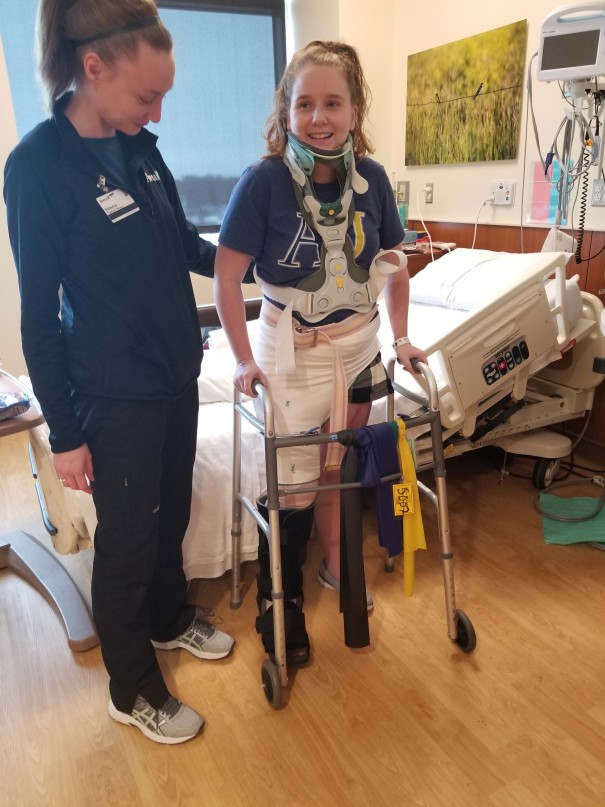
Just nine weeks into the recovery process Green started to learn how to walk without putting any weight onto her right foot.
On Jan. 11, Tate Green stood in a court room with the woman who decided to drive drunk and subsequently changed the rest of the 24-year-old woman’s life.
One year and almost three months after the accident, Kelli Tyrrell, the drunk driver, was sentenced to 10 years in the South Dakota State Penitentiary—five in suspension—as she stood in front of Green and the two other victims that she also injured on a late October night two years ago.
On Oct. 25, 2019, Green was dog-sitting for her parents when the dog was hit by a car. Green, along with the driver, 38, and three 15-year-old passengers, went to assist the injured animal in the road. Two of the teenagers attempted to alert traffic with their cell phones. Tyrrell, 60, did not respond to these attempts, and the two managed to get out of the way.
This was not possible for Green, the 38-year-old driver and the other teenager.
Tyrrell, of Brandon, was driving impaired and struck the three women with her GMC Sierra pickup truck. Green’s body was drug underneath the truck. One of the teenaged girls was thrown into a barbed-wire fence that, luckily, kept her from falling into the water below.
During the Jan. 11 sentencing, it was revealed that Tyrrell had consumed five to six beers and three shots of Fireball whiskey before getting behind the wheel of her uninsured vehicle. During her pre-sentencing, Tyrrell admitted to drinking more than she should have and even said that her friend had urged her not to drive.
Additionally, her blood test came back positive for THC, meaning that she had consumed marijuana relatively recently at the time of the accident. Tyrrell blew a 0.21 blood alcohol level—a level that is almost three times over the legal limit.
Testing of Tyrrell’s vehicle showed that she was speeding prior to the incident and at one point, the vehicle had reached a speed of 62 miles per hour.
Tyrrell completed a 12-hour intervention program, but while out on court’s bond with a condition of no alcohol consumption, she was found drinking at a casino in Brandon, where she blew a 0.109—also over the legal limit.
The aftermath
Green has no recollection of the accident, nor does she remember any moment of that October. She remembers waking up after she had been in the hospital for a month.
“I don’t remember anything in trauma or the ICU,” Green said. “I remember, like, the the ICU,” Green said. “I remember, like, the end of November. I’m thankful that it hasn’t come back. That’d be really hard to remember that.”
What followed the accident was a long hospital stay—75 days—for Green who suffered from a brain bleed, brain contusion, numerous broken bones in her extremities, a broken pelvis, several broken vertebrae, a hip dislocation, an open ankle fracture dislocation and a host of scrapes and bruises all over her body. Her medical bills totaled more than $1 million.
Impact statements
Four-hundred forty-four days after the accident, Green found herself in the same room as Tyrrell to deliver her impact statement. Green said this was the only time she cried during the trial.
“I think, at the trial, I just kind of pushed any anger or happiness or whatever way down, until it was all done,” she reflected.
During her statement, Green listed off the host of injuries she sustained, including the psychological effects of the accident. She stated that the paramedics said she had temporarily stopped breathing, she was intubated in the Intensive Care Unit for almost two weeks, had rods placed in her back to fuse her spine and nearly faced amputation of her foot.
This was only a small fraction of what she’s endured, but the effects, she says, are lasting.
“Your recklessness is now permanently written on my body,” Green said to Tyrrell in her statement.
The three victims were not required to go to the sentencing, but Green said she wanted Tyrrell to see the repercussions of her choice to drive drunk.
“All three of us were there facing her, like, ‘Do you not see what you did?’” Green said.
Tyrrell showed no remorse throughout the trial, Green says.
“My dad and I kind of watched her the whole time,” she said. “You know how when someone starts to get emotional, their breathing changes? Her breathing did not change. If you see someone who’s starting to cry or starting to get overwhelmed, their body rattles when they breathe in, but we didn’t see any of that.”
Both of Green’s parents, Cindi and Lee, also gave impact statements—describing the emotional trauma of watching their daughter suffer and the long road to recovery.
In Lee Green’s statement, he talked about his brother who was killed by a drunk driver in 1994. He explained that the young man who killed his brother worked two full-time jobs to support his family and stood up in front of the court to take full responsibility for his actions.
Lee described how he asked the judge not to sentence him to any more than one year because he knew that the young man recognized his mistake and was truly remorseful. Lee said he later coincidentally ran into the man, who pulled out a picture of Lee’s brother that he always carries with him to remind him of what he did.
This, Lee said, was why he only asked the judge for a year. But for Tyrrell, he asked the judge for the full sentence since she was showing no remorse and had taken no responsibility for her actions.
The sentencing
Tyrrell’s lawyer defended her case saying that his client had asked many times when she could apologize to the victims, that she showed up to the sentencing, that she stayed on the accident scene and “did render aid as best she could, until the ambulance got there, to one of the victims” and said that the amount of adrenaline Tyrrell most likely experienced would have made a difference on her performance of the field sobriety tests.
When Tyrrell made her own statement, it was succinct.
“Your Honor, I am deeply, deeply sorry for what happened,” Tyrrell said. “It’s the worst feeling in the world to know that you hit another person. That I am just deeply, deeply sorry. I’m sorry for all, everybody. I’m sorry. That’s all.”
This short statement was not enough to change Judge Susan Sabers’ mind, which she said she had already made up even before hearing the impact statements and seeing photos of the accident.
“It is, I think, probably one of the worst ‘accidents’ I’ve ever seen,” Sabers said. “And I use the word ‘accident’ in air quotes there because behind this accident was an intentional choice to drink excessively, an intentional choice to speed and an intentional choice to get behind the wheel of a car.”
“I don’t know what it feels like to be involved in such a terrible accident,” Sabers continued. “But to have alcohol at the heart of that accident and ever consider touching a drop of it again for any reason whatsoever I think compounds the problems, the difficulties and the scariness factor of what happened here.”
“I am going to use every day of the penitentiary time that is available to me. That includes the full 10 years, five of which will be in suspension. Quite frankly, folks, if I had more to use, I would, because I think the facts of this case require it.”
Tyrrell was ultimately sentenced to 10 years in the penitentiary—five years suspended. Additionally, she received a three-year driver’s license loss on top of a 30-day driver’s license loss, a $50 surcharge for the DUI, $300 for testing fees and $6,701.50 in restitution for one of the victims.
Tyrrell’s lawyer asked the judge to grant her until the end of the week to get her affairs in order before entering the penitentiary. Sabers denied the request, saying she had over a year to get this in order. Tyrrell was then immediately taken into custody.
Tyrrell’s sentence feels right to Green. This, however, isn’t the end of the road and wasn’t the closure Green thought she might get.
“The sentencing was on a Monday and then the next day I had my last post-op for the last surgery,” Green said. “I’m still going to be recovering and doing physical therapy for a while yet, so it’s not done. I probably won’t consider it done for a good majority of my life.”
Recovering, restrictions
Overall, Green says the recovery process has been tough. Her most recent surgery was in late November and was hopefully her final one—of the nine or 10 surgeries she’s had to endure since the accident.
“All restrictions have been lifted as of this point, so I’m slowly starting to get back into more physical things which is great, but also terrifying at the same time,” Green said.
For many people, transitioning back into exercise probably wouldn’t mean jumping back into the world of martial arts. But for Green, that’s exactly what this meant.
The Green family owns Circuit Martial Arts & Fitness in Brandon where Green teaches.
Green was back at the center just a few short months after being released from the hospital, starting with front desk duties. Soon enough, she transitioned back into teaching up until Nov. 30 when she had her final surgery.
It hasn’t been all smooth sailing, but Green wants to do right by her students.
“Of course, I don’t want to just halfway do the form, so I’ve gotta give it my all, but giving it my all makes me hurt by the end of the day.”
As of about two weeks ago, Green is back to teaching—not letting her last surgery hold her back from doing what she loves.
“I’m on the mats most of the week—four out of the five days we’re open,” Green said.
She estimates she’s 75 to 80 percent back to normal physically.
Focusing on positivity
While she may face continued physical struggles, Green says she’s in a good place mentally.
“Mentally, I’m probably 100 percent back—probably better than what I was beforehand,” she said.
She attributes this mental triumph and physical progress to the positive attitude that she’s maintained from the second she woke up in the hospital.
“Part of why I’ve been doing so well and getting closer to being back to normal is that I have had a positive attitude about it, my family has kept a positive attitude about it,” Green said. “When I was in the hospital, I never wanted to think about the negative. I never wanted to think about getting back at her. If I had just focused on the anger and frustration, I would not be where I am today.”
With a generally positive disposition even before the accident, Green says the only struggle she faced was not having an outlet for the frustration she did encounter.
“The only hard thing was if I’m really frustrated or upset, I’ll hit bags, but I couldn’t do that because I had restrictions,” Green laughed.
Consequences
Despite her positive attitude, Green knows that this is something that will stay with her forever, but you won’t hear her complain. Instead, she uses her situation as a lesson in consequences for students.
“This is the second time this has happened to my family,” Green said. “It should not happen at all. That’s part of the reason I feel like it’s important to talk about. Secondly, at Circuit, we teach that things have consequences. So, talking about it is showing them there’s a consequence, and it’s a consequence I have to live with for the rest of my life. All three of us.”
Green said Circuit is starting to enroll students who have no idea about the accident nor what she’s been through, and she doesn’t bring it up.
Despite the difficult conversation that her accident can conjure up with kids, Green has also been pleasantly surprised by the understanding and compassion her students have shown her.
She gives the example of a ‘fun week’ they hosted at Circuit when school started. For the week, the kids were able to exchange their uniforms for clothes that fit the theme of the day. The last day was beach day, and Green allowed her students to wear shorts and t-shirts—but definitely no swimming suits, she added, laughing.
Green, who has scars on her legs, also wore shorts that day, even though she worried about what the kids might say.
“We always wear long pants, so they don’t see it. They saw part of the scar that was on my right thigh, and no one said a word. Until the very last class, after everyone had left, there was one student who really likes to talk and he was asking about it. I started to explain, and his mom was like, ‘Remember? We talked about this a little bit.’ And he goes, ‘Well, why didn’t you just let it scab over?’” Green laughed. “I was like, ‘Well, unfortunately, that would not have worked out. I wish I could’ve just let it scab over.’”
With another surgery consultation in February and additional physical therapy ahead of her, Green still has a way to go in her recovery. But, she serves as a shining example of positivity, perseverance and strength. However, she doesn’t want anyone else to have to be this same example.
“Just don’t drink and drive,” Green stressed. “It’s not a great idea at all. If you know that you’ve had way too much, then get a ride—there’s Lyft. Don’t be dumb about it. I always tell my friends, ‘If you need a ride, I will come get you. We’re not doing this again.’”

