
Commission votes 5-0 for refugee resettlement Minnehaha County
By:
Dave Baumeister, County correspondent
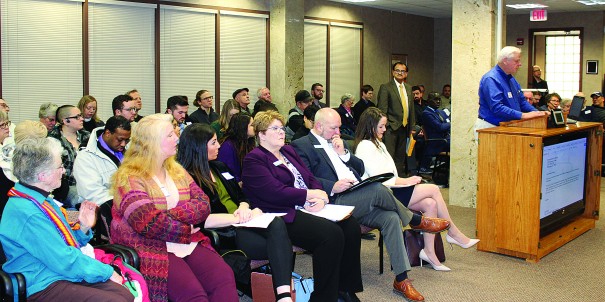
People filled the Minnehaha County Commission chambers on Tuesday, Jan. 14, to speak about a requirement following a federal executive order to sign a document before allowing refugees to be located into a community. 20 people spoke in favor of refugees and the positive impact on the local labor force. Five people spoke against the resolution. One person who has voiced anti-refugee sentiments in the past, former state senator Neal Tapio, seated in the bottom right of the photo near the exit door, did not speak. Commissioners voted 5-0 to sign the document.
SIOUX FALLS – Although South Dakota’s most prominent “anti-immigrant politician,” Neal Tapio was present at the Jan. 14, Minnehaha County Commission meeting, he did not add his voice to the five people who spoke against the resettlement of refugees in the county.
Tapio, a Watertown resident and former state senator who ran unsuccessfully for the U.S. House of Representatives in 2018, may be most widely known as the 2016 director of the Trump campaign in South Dakota.
Tapio has been quoted in the media and on his Facebook page as criticizing the “crime-ridden” city of Sioux Falls and Lutheran Social Services for brining refugees to the area.
Tuesday’s meeting would have been a perfect opportunity for Tapio to express his reservations as county commissioners considered whether or not to sign a resolution allowing more refugees into the area.
As was reported last week, due to an executive order signed in September 2019 by President Trump, before accepting any of the 18,000 refugees allowed into the U.S., both the states and communities impacted have to sign letters to that effect.
At the previous meeting, Betty Oldenkamp and Rebecca Hudsen of LSS in Sioux Falls told commissioners of the need for the signed document, which commission chairwoman Jean Bender then put on the agenda for Jan. 14.
The issue before the county was simple – whether or not to sign the relocation document.
Gov. Kristi Noem signed it on behalf of the state last month.
The Sioux Falls City Council also voted Jan. 14 unanimously to sign the document.
The commission chambers was packed with more than 60 people, with many more in the overflow room. While most in the commission chambers seemed to be in support of area refugees, 20 people spoke to ask commissioners to vote “yes” on the resolution.
Several of those who spoke told their own stories, sometimes tearing up about being forced from their home countries and becoming refugees, and how welcoming Sioux Falls had been to them.
Adding to this were voices from the Sioux Falls Chamber of Commerce, Forward Sioux Falls, the AFL-CIO, among others, all noting the positive impact of the current refugee community has on the city and county labor forces.
Only five individuals spoke in opposition, of which two shared they were not so much against the resolution but pointed out that Sioux Falls already has problems, such as the disabled veterans and homelessness, that needs to be addressed first.
Another mentioned that the vetting process needed to be better, even though it was explained in answer to a question by Commissioner Dean Karsky that the FBI and the Department of Homeland Security already handled that as part of an 18- to 24-month process.
Minnehaha County and the City of Sioux Falls are not involved with the vetting and security clearances.
The number of refugees expected by LSS is between 60 and 100.
Oldenkamp said that 130 refugees were relocated in Sioux Falls last year, and she based the new figure on the fact that Trump had reduced the total number allowed into the country by 40 percent.
Although Tapio himself avoided the podium, one of three others against specifically referred to Tapio, and another read from “talking points” that had been circulating citing anti-refugee “statistics.”
(Tapio did speak at the City Council meeting later that evening, and referred to some of those same “talking-points.”)
Following public comment, all five commissioners weighed in on the reasons why they supported it.
“I am not going to be a voice against (welcoming people),” Karsky said. “If we go back far enough, all of us came from that situation.”
Commissioner Gerald Beninga added, “I enjoy the culture they bring. I am going to support this because it is the right thing to do. The vetting process is extraordinary, and (the refugees) create benefits for our economy.”
Commissioner Cindy Heiberger said conversations like this are good to have.
“We need to be speaking to each other,” she said. “If there is a fear, we need to be talking.”
Then she mentioned the state’s European immigrant heritage.
“There are still people in South Dakota who only speak German.”
The commission’s action on Tuesday may have been in vain by Wednesday qhwn U.S. District Judge Peter J. Messitte of Maryland temporarily halted the presidential executive order.
Still, Minnehaha County commissioners reiterated the conversation is a good one to have.
One of the “talking-points” mentioned was an “increase in crime,” but Bender said that she had talked to both human services and law enforcement who said that there was no disproportional need of their services among the refugee population the county.
“Any time you try to categorize a group with one broad stroke, you miss the whole picture,” she said.
Commissioner Jeff Barth put it simply, “It’s easy to hate people. Let’s not hate each other. Let proponents not hate opponents, and let opponents not use this for political ends. (At the beginning of the meeting), we said the Pledge of Allegiance – ‘with liberty and justice for all’ – for all. I’m going to support this because it is the American thing to do.”
On a motion from Beninga, and a second by Karsky, the resolution to allow refugee resettlement in Minnehaha County passed unanimously.
Following the vote, the room erupted in spontaneous applause.
The Minnehaha Commission has its regular meetings each Tuesday at 9 a.m. on the second floor of the county administration building at Sixth and Minnesota in Sioux Falls. These meetings are open to the all, and public comment is always encouraged.

